Data Center Dilemma
Authors: Kyle Terry, Joseph Roarty
The emergence of artificial intelligence and data centers as the centerpiece of US economic growth - with AI-related investment comprising approximately 25% of US GDP growth by some sources - creates all sorts of questions for policymakers at every level of government. Broadly speaking, policymakers of the past decade have invited in and fought for data centers in their communities with promises of lofty tax revenue and job creation. However, the true costs and benefits can be ambiguous, misrepresented, and vary greatly from one community to the next. This post breaks down the stories and data behind data centers that is necessary for any informed policymaker or consultant to know.
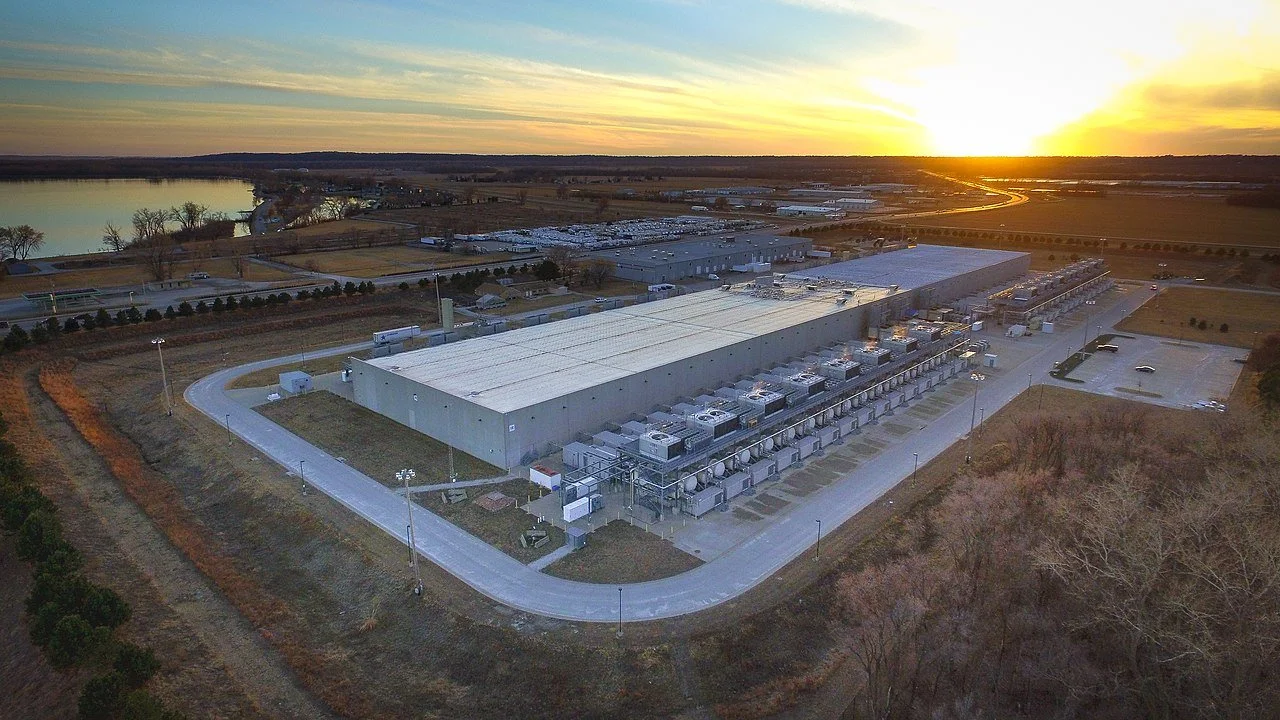
Aerial view of the Google Data Center in Council Bluffs, IA. 18 February 2017, 17:42
Source: Chad Davis, Flickr
Resource Consumption
Broadly speaking, the first resource used up by data centers is simply space. These facilities take up huge tracts of land, usually hundreds of acres but sometimes THOUSANDS. The land they typically end up on is often prime land of one sort of the other, such as untouched nature or, in the case of many clients we work with in Illinois, some of the most fertile farmland you can find in the United States. And beyond the hundreds of acres being dominated by one large scale, uninteresting (visually - the insides are fascinating), private use, another issue we run into with clients is the pressure on a community’s identity, be it one of outdoor recreation or a historic farm community.
Data centers are also growing consumers of electricity and water, driven by their energy intensive operations and cooling requirements. Data centers are expected to triple their total energy usage by 2028, and will account for 12% of US energy usage[1]. On average, a single data center can use up to 2 megawatt hours (mWh) of electricity, which is comparable to the power consumption of a small town1 - yikes! An $800 million data center announced last year near Cheyenne, Wyoming is expected to begin operation at 1.8 gigawatts (gW), consuming more electricity than every home in Wyoming combined[2].
Data centers often help pay for the new infrastructure required to run their facilities, but this cost is shared by local consumers. The prices for transmission, infrastructure expansion, and energy generation are all affected by new data centers[3]. Additional demand on the power grid from data centers often exceeds the speed at which supply can increase. When renewables can’t support demand, data centers will turn to dirtier but more reliable sources of energy, like methane powered generators in Memphis[4].
Data centers create heat when consuming energy for training AI, cloud computing, and large-scale processing. To combat this, there are two primary manners to cool a data center: water-based cooling systems and air-based cooling systems. Water-based cooling systems are energy efficient but water intensive, and these systems account for the cooling process for 22% of data centers as of 20241. Closed loop systems that recycle water or harvest rainwater can reduce freshwater use, but a single high-volume data center can still consume 5 million gallons per day, comparable to the water use of a town of 10,000 to 50,000 people[5]. Communities around the US have reported loss of tap pressure and sediment in their watershed following the construction of data centers. Alternatively, air-based cooling systems are water efficient but energy intensive, thus adding further demand to the local grid.
To put it frankly and plainly: there is no such thing as a sustainable data center, only an environmental compromise. And that can be okay as long as developers and policymakers are honest with the communities they want to build in, and each new data center development is continually pushed to be more sustainable than the last.
Economic Impacts
Here is the fun part, right? Not only is this the type of data The 1861 Group loves to dig into, but these are the stories that are pushed for community buy-in. Now let me quote Jay-Z to tee up this conversation: “Men lie, women lie, numbers don’t.” I wish the next line had been something like “But it’s men and women that misquote economic growth, and in response I say ‘nope,’” but that would 1. make a mediocre bar and 2. doesn’t rhyme all that well, so I’ll just say: The figures often quoted by data center developers are not inherently false, depending on the lens you look through - their figures must hold up in court, after all. It is not my desire to discredit the people who are coming up with their economic impact numbers - I have just seen under the hood of too many economic impact models to know a small stretch of assumptions or a pull on a specific lever can make numbers say essentially what you want.
Data centers promise job creation as one of the key benefits to the local community. The initial construction brings millions of dollars of business to local economies, creating as many as 1,500 temporary jobs (mostly construction) in the short run[6] which in turn boost ancillary job creation, at least in the short term. In the long term, data centers create far fewer permanent jobs, typically between 50 - 150 per site[7]. Additionally, many of these jobs are low-paying, non-technical positions such as security guards, custodial staff, and maintenance. The higher paying, technical positions require advanced degrees that often can’t be filled by the local labor supply of rural areas where new data center development is being pushed in the US, ferrying the benefits of higher paying jobs outside of the community[1].
To have a full perspective on the employment created by data centers, policymakers need to consider alternative land uses and public investment per job created. In the case of Abeline, Texas, a one million SF data center currently being built will have 100 full-time employees, while a 286,000 SF cheese-packaging plant built in 2021 employs roughly 500[6]. From a land use perspective, data centers are not an efficient way to add jobs to an economy, not to mention can create significant gaps in the urban fabric and spatial efficiency of an economy. Alternatively, data centers are not an efficient way to create jobs from a public investment perspective either. In Illinois, Microsoft secured $38 million in sales tax exemptions while creating only 20 jobs, resulting in a public investment of $1.9 million per job[8]. Likewise, developers in Genesse County, Alabama, are seeking $167 million in tax breaks to create 200 jobs, or $838,000 per job[1].
The primary motivator for policymakers to bring data centers to their communities besides jobs is that sweet, sweet tax revenue. Data centers’ state and local tax burdens are highly dependent upon local policy choices and are difficult to calculate. In 2017, the average data center generated $1.1 million in state and local taxes annually[9]. Prince William County, Virginia, home to forty-four data centers, generated a total of $293.7 million in tax revenue in 2024, roughly $6.68 million per center[10]. However, the state of Virginia, which doesn’t disclose its granular data, gave an estimated lump-sum exemption of $730 million to data centers in 2024[8].
So do data centers create significant tax revenue for a community? Yes, they do, and yet it’s still not nearly the full amount it could be, falls short of initial estimates, and is not as efficient in tax revenue generating as other land uses on the same site would likely be. States forfeit millions of dollars of tax revenue fighting each other to become the lowest bidder - your classic race to the bottom - subsidizing a trillion-dollar industry with public dollars.
Long Term Forecast
The road ahead for artificial intelligence and data centers is still uncertain. And while we don’t know a lot about what the future will hold, we do know that there are two large concerns about the future of data centers (that we’re calling out here). The first is that technological advancement will shift AI away from centralized processing or reach the point that our current infrastructure won’t support the latest hardware. With hyperscale data centers taking close to a decade to build, the fear that technological advancement will make current infrastructure obsolete in 10-15 years is warranted. Secondly, the huge valuations of the software companies building data centers makes building them an attractive investment. While buyers are frothy to invest in the construction of data centers, there are far fewer buyers of completed, operational data centers, making the exit difficult. Just 7% of data center investors are targeting completed projects, due to their long-term leases[11]. While these concerns remain hypothetical, the future use and viability of these buildings pose real risk to communities investing infrastructure in and economically relying on data centers.
What Should Communities Do?
This is not a plea to stop all data center deals. These deals are occurring and will continue to occur as long as it makes financial sense for investors. For many communities impacted by off-shoring, plant closures, brain drain, flight of capital, and any other of a long list of issues facing too many of our towns and neighborhoods across the US, any new tax revenue sure looks better than continuing with business as usual.
My hope is that this piece and a growing understanding of the full suite of impacts - both good and bad (which rarely make the promo materials from development teams) - will help communities take a step back, take a breath, and ask for a deal that makes sense for both the company and residents. That means ensuring infrastructure costs are not laid at the feet of taxpaying citizens. That means ensuring plans are in place for environmental impacts. That means making these facilities as resource efficient as absolutely possible.
Understand that if you can’t find a deal that works for your community, it’s okay to say no. Nothing is more desirable than the community that spurned you that first time. And if a data center ends up in the next community over, maybe understanding these negative impacts will make decisionmakers feel just a bit better about protecting their residents’ best interests.
If you are a policymaker, a developer, a citizen group, or anyone else with one of these deals on your doorstep, let’s talk! My phone is always on and my inbox is always open.
And lastly, of course there is an associated playlist with this post and subject - you’re reading the work of Mr. Mixtape himself. Please enjoy The 1861 Group Presents: Data Center Dance Mix on Spotify and let me know what you think! There is a follow-up post on the playlist coming next week.
Sources
1. Nguyen, T. and Green, B. (July 2025). What Happens When Data Centers Come to Town? University of Michigan, Ford School of Science, Technology, and Public Policy. https://stpp.fordschool.umich.edu/sites/stpp/files/2025-07/stpp-data-centers-2025.pdf.
2. Gruver, M. and O’Brien, M. “Cheyenne to Host Massive AI Data Center Using More Electricity than All Wyoming Homes Combined.” AP News, 28 July 2025, https://apnews.com/article/ai-artificial-intelligence-data-center-electricity-wyoming-cheyenne-44da7974e2d942acd8bf003ebe2e855a.
3. Honan, M. “Data Centers Are Amazing. Everyone Hates Them.” MIT Technology Review, 14 January 2026, https://www.technologyreview.com/2026/01/14/1131253/data-centers-are-amazing-everyone-hates-them/.
4. Brabenec, R. “A Billionaire, an AI Supercomputer, Toxic Emissions and a Memphis Community That Did Nothing Wrong.” Tennessee Lookout, 7 July 2025. https://tennesseelookout.com/2025/07/07/a-billionaire-an-ai-supercomputer-toxic-emissions-and-a-memphis-community-that-did-nothing-wrong/.
5. Yañez-Barnuevo, M. “Data Centers and Water Consumption”. Environmental and Energy Study Institute, 25 June 2025. https://www.eesi.org/articles/view/data-centers-and-water-consumption.
6. Dotan, T. “The AI Data-Center Boom Is a Job-Creation Bust”. The Wall Street Journal, 25 February 2025. https://www.wsj.com/tech/ai-data-center-job-creation-48038b67.
7. Bisaha, S. “Data Centers Bring Money to Small Towns. But Do They Also Bring Jobs?” NPR, 10 April 2025, https://www.npr.org/2025/04/10/nx-s1-5355017/data-centers-bring-money-to-small-towns-but-do-they-also-bring-jobs.
8. Tolockaite, A., Tortorelli, P., and Stevens, P. “In Race to Attract Data Centers, States Can Forfeit Hundreds of Millions of Dollars in Tax Revenue to Tech Companies.” CNBC, 20 June 2025, https://www.cnbc.com/2025/06/20/tax-breaks-for-tech-giants-data-centers-mean-less-income-for-states.html.
9. Data Centers: Jobs and Opportunities in Communities Nationwide. U.S. Chamber of Commerce, Technology Engagement Center. 1 May 2017, https://www.uschamber.com/assets/documents/ctec_datacenterrpt_lowres.pdf.
10. 2024 Data Center Industry Tax Revenue Report. Prince William County Department of Finance, 2024, https://www.pwcva.gov/assets/2025-06/Prince%20William%20County%202024%20Data%20Center%20Revenue%20Report.pdf.
11. Dale, N. “Data Centers Face Exit Challenges Amid Investor Hesitation.” CRE Daily, 29 Sept. 2025, https://www.credaily.com/briefs/data-centers-face-exit-challenges-amid-investor-hesitation/.